
HOME

• Quick Picks

• Roger's Choice
• Under £5
• Top 20 Sellers
• New Books
• Special Reviews
HOME |
| • Quick Picks • Roger's Choice • Under £5 • Top 20 Sellers • New Books • Special Reviews
|
 HELP |
| Roger's
Active Learning Bookshop All profits go to Save the Children. [View total] |
||
|---|---|---|
 |
   |
 |
|
| If
organisations
are to remain competitive, and develop the highly skilled people that
will contribute to their future performance, improving learning
transfer should be a priority. Cyril Kirwan's book addresses this
critical issue at a number of levels: Firstly, it explores what learning transfer actually is (it's about application of learning back at work, as well as maintenance of that learning over time). Secondly, it describes the main factors that affect transfer, in terms of trainee characteristics, training design factors, and work environment characteristics. It also examines how those factors exert their effect, which ones are more important, how they interact with one another, and in doing so constructs a practical learning transfer model for practitioners. Thirdly, the book describes in some detail what the various factors working for or against learning transfer look like in practice. Finally, using case studies, it points the way towards what can be done before, during and after training to improve the rate of transfer. This highly practical book will help trainers, development specialists and line managers ensure that their training is about real outcomes and not just inputs. (adapted from Amazon.co.uk) Dr Cyril Kirwan is an experienced management and organisation development consultant. He holds a M.Sc. in Work and Organisational Psychology from Dublin City University, and a Doctorate in Business Administration from Henley Business School. He is a certified management consultant (CMC), a member of the Irish Institute of Training and Development (MIITD), a Chartered Fellow of the Institute of Personnel and Development (CFIPD) and a Visiting Academic Fellow at Henley Business School. (adapted from Amazon.co.uk)   |
 |
Synopsis:
Why don't best practices spread within firms? What exactly is sticky
knowledge? Having recognized that knowledge assets are rapidly becoming
their most precious source of competitive advantage, a large number of
organizations are now attempting to transfer best practices. Yet best
practices still remain stubbornly immobile. Sticky Knowledge reveals
that the transfer of practices is a complex phenomenon, and
demonstrates the range of barriers to transferring best practices
within the firm. Written in a brief and accessible format, Gabriel
Szulanski defines the popular concept of stickiness and its
operationalization, providing a roadmap for understanding and further
researching this topical issue. Taking a fresh look at accepted wisdom,
and presenting new research findings, Sticky Knowledge will be
essential reading for academics and students addressing issues related
to knowledge and the firm. Practising managers and MBA students will
also find this book of immense value.
(Amazon.co.uk)
|
 |
Review:
Sticky Wisdom should be required reading for anyone who's ever wondered
how to have more fun at work and profit by it. The basic message is
that creativity is like gold dust but it needs to be practised and
worked at in organisations. It needs to become part of the
organisational furniture. Dave Allan and his co-authors run ?What If!,
a creative consultancy (and the title of the first edition) aimed at
helping businesses move outside the proverbial tramlines and here,
minus the fee, they show how, with activities, games, insights and
general lunacy. The basic premise is that there are six main ways of being more creative--from thinking about things afresh through greenhousing (letting good ideas grow) to bravery (making them happen). Each chapter presents a range of case studies that help ground the activities in a sense of reality--for example one client managed a breakthrough in their advertising for toothpaste when they started seeing their product as liquid teeth. Where many management books are drier than a diver's underpants this has a freshness and zing about it. It keeps you reading and it keeps you smiling too. Sticky Wisdom sends a rocket into the comfortable world of conventional thinking. (Steve Morris, Amazon.co.uk) You can download chapter one for free at http://www.whatif.co.uk (which is worth a visit anyway) |
 |
Book Description
This guide will help you track the results of post-training
performance.
|
 |
The whole book is based around
a 3x3 matrix that shows what the
manager, trainer and trainee
can do before, during and after a training course to assist the
transfer of learning. The answer is a list of
80 strategies. Most strategies are common sense, but most readers will
find a few new ideas here -
with many brought to life in case studies. You will never have the time
to apply all of these
strategies, but your training events will benefit from the systematic
partnership approach
that is encouraged by the authors and supported by their research. 'Transfer of Training' is really about generating a culture of transfer. This is emphasised by the fact that over half of the strategies described (41) are for managers, whereas only one sixth of the strategies (14) are for learners. (Trainers have 24 strategies to choose from). In the spirit of partnership, most of these strategies involve working with others. By focusing on how managers can support transfer, this will help to remove some of the major organisational blocks to transfer. But learners also need to take significant responsibility for transfer, and for a more through understanding of this aspect of transfer you may want to take a look at other sources such as Haskell's book below. (reviewed by Roger Greenaway) |
| Synopsis:
Picking up where her first book left off, Mary Broad offers a "next
generation" update on her 1992 classic text Transfer of Training. In
this new book she translates new research into guidelines, checklists,
and case studies that help practitioners plan and implement proven
transfer strategies, identify high-priority performance requirements,
find key stakeholders as partners for specific projects, coordinate
stakeholder support actions, and evaluate and disseminate outcomes.
(amazon.co.uk) From the inside flap: Beyond Transfer of Training ... includes a step-by-step process tool for consultants and managers to collaborate, analyze performance problems, recruit other stakeholders, develop and implement a performance improvement intervention and evaluate outcomes. In addition, this handy resource
|
 |
Synopsis:
This text addresses the problem of how our past or current learning
influences, are generalized and are applied or adapted to similar or
new situations. It illustrates how transfer of learning can be promoted
in the classroom and everyday life. (amazon.co.uk)
Reviewed by Roger Greenaway: This book appears to be
a thorough review of research about the transfer of learning over the
last 100 years from which 11 practical principles are drawn. It looks
like the solid rock on which any transfer strategy should be based. It
isn't. Which is just how Haskell writes: "It isn't", "It doesn't", "It
won't". This relenting chorus shoots away theories and assumptions
about transfer until nothing much is left. The grim news that very
little transfer of learning happens in education or training could make
practitioners feel relatively satisfied with a success rate of only
20%. Haskell points at the failure of research to demonstrate the
effective transfer of learning, but he himself fails to explain
adequately why transfer has such a lamentably poor record. |
 |
Synopsis: This book presents a
straightforward 12-step approach to
results-oriented training that links training courses directly to
important business needs, problems and opportunities. The authors
explain how human resource development professionals can develop
collaborative "client-consultant" relationships with line managers -
and then make the relationships yield better management support for
training efforts.
Review:
"This is a timely book that provides training and development
professionals with practical hands-on tools to document the
contributions of their training efforts. I predict that this book will
serve as THE handbook for future tracking and cost justification of
training and development efforts." Gary Martini, president of Martini
and Associates, Human Resource Consultants. |
 |
Book Information:
Presents a breakthrough research on knowledge transfer, revealing five
proven methods for making knowledge sharing a reality. Provides a
competitive edge for all companies involved. DLC: Organizational
learning. From the Back Cover: "The hope of 'knowledge management' will remain unfulfilled unless organizations learn how to tap into not just their employees' facts and observations, but their hopes, fears, dreams, and feelings. Nancy Dixon has studied the ways in which knowledge truly spreads, and she describes the practice in real-life detail, blending a keen feel for organizational design, in-depth research, practicality, and high spirits." -Art Kleiner, Coauthor of The Dance of Change and Author of The Age of Heretics Nancy Dixon's book comes to the rescue of anyone faced with dilemma of needing to do something and not knowing what. It raises above all the hype and panic to give clear, practical advice. Professor Dixon defines five distinct types of knowledge and illustrates them with real life examples. She goes on to show that these types of knowledge need different methods of propagation. In other words the medium and the message must work together to deliver the goods. Some types of knowledge are indeed amenable to a database approach. But surprise, surprise - some are not. It all depends on why you want to transfer the knowledge and what kind of knowledge it is. (from an anonymous review at amazon.co.uk) |
See Roger's
review of Learning to Fly (which includes a comparative
review with Nancy Dixon's Common Knowledge) See
more reviews at Amazon.co.uk See
reviews and 'inside the book' at amazon.com
Practical Lessons from One of the World's Leading Knowledge Companies
Chris Collison, Geoff Parcell
Also see LEARNING
ORGANISATIONS for more books about the transfer of knowledge
within organisations.
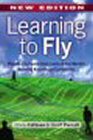
Book Description
Learning to Fly shows exactly how to put theory into practice, sharing
the tools used and the experience and insights gained by two leading
knowledge management practitioners. In Learning to Fly, Chris Collison
and Geoff Parcell share their experiences from BP, one of the world's
leading knowledge organisations. It is a practical, pragmatic workbook
packed with hints and tips to help managers put knowledge management
into action immediately.
| Evaluation and Research Publications by Yoland Wadsworth | ||
| Learn more about 'Building in Research and Evaluation' | ||
 |
Synopsis: This handbook aims to provide everything a trainer needs to know about the effective evaluation of training. It provides information on the design of the evaluation process and advice on when and where to use particular types of tests. The book covers the complete range of approaches to evaluation that are available. With advice on the use of Likert and Thurstone scales, process tests, observation of skills and behaviour, activity analysis, reflective self-reporting, interim evaluation, spot checks, validation and the use of questionnaires, the book aims to provide the definitive compendium of training evaluation tests. (Amazon.co.uk) |
 |
Synopsis: Presents the strategy and tools needed to turn a training/HRD department into a visible, indispensable profit center. Provides user- friendly ROI calculations as well as ten post-program data collection methods; ten strategies for determining the amount of improvement that is directly linked to training. (Amazon.co.uk) |
 |
Synopsis: Stirring the creative juices in organizations today requires a new mindset regarding goal-setting and performance-evaluation. This work offers the critical requirements for setting and achieving performance outcomes and goals. The author divides each chapter into a "Mindbook" section, explaining concepts and ideas, and a "Workbook" section with detailed examples and exercises. Emphasizing the outcomes as opposed to the actions in setting goals, the author provides the what's and why's behind today's performance challenges and shows how to convert them into measurable, concrete achievements. Each chapter offers strategies and exercises for setting goals and gauging performance. The examples are of an interactive nature for readers to try on their own. The book is written for people at all levels of the organization and is applicable to any industry. (Amazon.co.uk) |
 |
Publisher: Sage Publications Ltd;
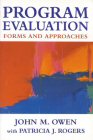
ISBN: 076196178X Synopsis: A practical introduction to evaluation for students, academics and researchers in the social sciences. The book shows how to identify appropriate forms and approaches using an original framework, examines the role of evaluation and shows how to involve stakeholders and disseminate findings. (amazon.co.uk) This book is the prescribed text for the Program Evaluation course at the Centre for Program Evaluation, University of Melbourne. Course description: A conceptual overview of theories, issues and recent practice in evaluation. An inductive/case study approach is used in which recent evaluation practice is analysed using frameworks developed by the lecturers. Topics covered include: conflicting views on its nature and purposes; alternative purposes (summative, formative, illuminative); forms and approaches adopted by external and internal evaluators; evaluation and performance auditing; responsive evaluation; links between evaluation, decision-making and action; planning evaluations; an introduction to various qualitative and quantitative evaluation techniques in data management; reporting evaluation findings; evaluation ethics and standards; and a critical appraisal of selected Australian evaluation studies. |
| Book Description:
This book offers practical ways to plan evaluation and develop tools to
record and report learner growth. The underlying theme is that good
evaluation involves the learner throughout the whole learning
experience and is not simply a judgment by an instructor at the end of
a course. The book systematically reviews many aspects of learner
evaluation from different perspectives and provides practical
suggestions about how to conduct evaluation in different contexts to
benefit all concerned. The Art of Evaluation is essential reading for educators and prospective educators who are concerned about the critical role of evaluation in the learning process, and want to know how to improve their own assessment approaches and enable learners to assume active, meaningful roles in evaluating their own learning. Sample pages (html and pdf) |
| Book Description: The book encompasses six functions
or levels of evaluation that are keyed to the major stages involved in
the design, development, and implementation of interactive learning
systems or products such as multimedia DVD’s, Web-based
training, electronic performance support systems, and e-learning
solutions. Various chapters in the book link evaluation procedures and
tools to specific design and implementation activities to help novice,
as well as experienced, evaluators plan, conduct, and report better
evaluations. Many of the methods and tools in this book can be used for
multiple functions. This associated Web site includes downloadable
tools and guidance about how to use them in various types of
evaluation. Book Review: Finally, a comprehensive, easy to understand book on the evaluation of interactive learning at a time when most needed and by authors with decades of practical and interesting evaluation experience. This book provides an overview of evaluation components and ethical considerations for the most novice as well as a highly useful set of checklists and forms for those already in the evaluation trenches. (Reviewed by Curtis J. Bonk). See more reviews at the book's website. |
RECORDING
YOUTH DEVELOPMENT
| Q. What's popular? A. See The Top 20 Q. What's best? A. See Best Books Q. Where are the bargains? A. They are all on one page at Books Under a Fiver Q. What's new? A. See New Books or browse the right margins in any category. Q. Where am I? A. Roger's Bookshop is part of The Active Reviewing Guide. |
| Amazon.com Returns Policy |
|
Amazon.co.uk Returns Policy |
|---|
 See
today's Hot 100 Books at Amazon.com See
today's Hot 100 Books at Amazon.com |
See
today's Hot 100 Books at Amazon.co.uk  |
| For
news of new active learning book reviews monthly tips & articles about active learning subscribe for free to Active Reviewing Tips Roger's monthly ezine for dynamic facilitators. |
To
navigate the Active Reviewing Guide Start at the Home Page or Find your Search Profile or Use the Main Search Page |
HOME |
 HELP |
